
Chemical Plant Flooring That Resists Corrosion and Contains Spills
In a chemical plant, the floor is the last barrier between a spill and the concrete, the drains, and the ground. Surface Technology installs and repairs chemical-resistant floors, linings, and secondary containment, and plans the work around your process and your shutdown windows.
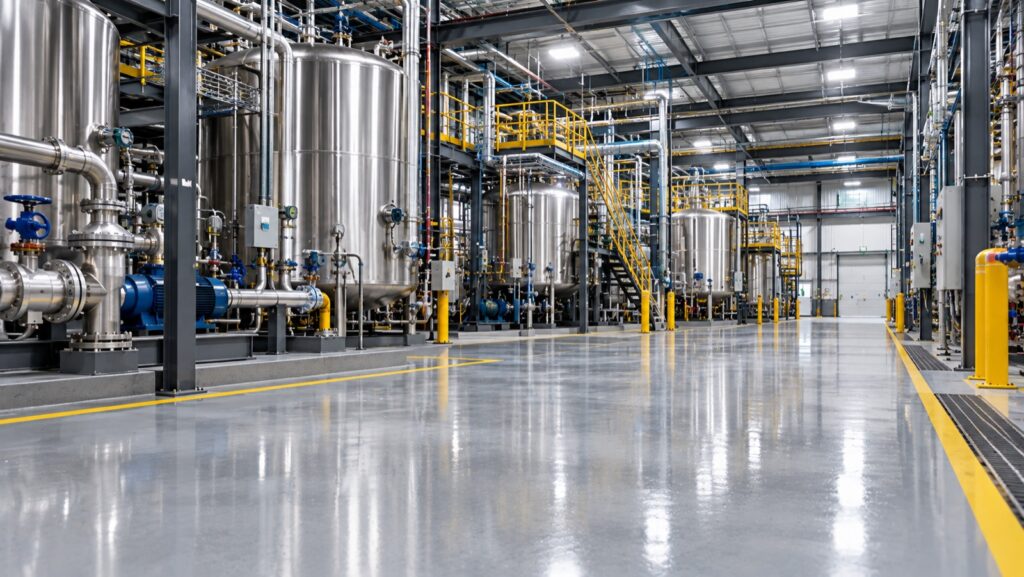
What a failed floor costs in a chemical plant
Acids, caustics, and solvents attack uncoated concrete. It softens, pits, and sheds dust, and the damage spreads under the slab where nobody can see it. A coating that is wrong for the chemical blisters or dissolves at the first spill, and the repair has to happen around a process that does not like to stop.
The cost is not only the floor. It is a hazard underfoot, a containment failure, and a shutdown nobody planned.
What we look for on a site walk
- Pitting, softening, or dusting where chemicals have reached the concrete
- Blistering or delamination of existing coatings
- Cracks and open joints that let liquid reach the slab
- Failed curbs, sumps, and trench edges
- Slippery spots where spills and washdown overlap
- Transitions where different systems meet
Matched to the chemicals, not just the room
Start with what has to be resisted
Chemical resistance is specific. A system that handles caustic cleaners can fail against a strong acid or a solvent. We ask what is stored, handled, and spilled, at what concentration and temperature, and we work from the Safety Data Sheets. Then we specify the system to match.
Systems we install
Epoxy and Novolac epoxy for general chemical exposure, vinyl ester for the most aggressive exposures, urethane cement where heat and washdown meet chemicals, and fast-curing MMA when the window is short. Seamless systems leave no joints for liquid to reach the slab.
Containment that holds
Secondary containment linings and coatings hold a spill until it is cleaned up. A lining is typically 30 to 90 mils thick. A coating starts at 90 mils and can exceed one-eighth inch. They apply to any material with a Safety Data Sheet.
Every area has a different exposure
We do not put one floor through the whole plant. We look at what each area sees, then choose the system.
Process and production areas
Splashes, spills, and heavy equipment. Chemical-resistant epoxy or Novolac epoxy, matched to the chemicals.
Chemical storage and loading
Frequent spills and forklift traffic. A chemical-resistant system with abrasion resistance and slip texture.
Tank farms, sumps, and containment areas
Holding a spill until cleanup. Secondary containment linings and coatings.
Laboratories
Solvents, acids, and easy cleanup. Seamless chemical-resistant epoxy or urethane.
Wash and wet areas
Hot water, caustic cleaners, and drainage. Urethane cement with slip-resistant texture.
Areas that cannot be down long
A tight shutdown window. Fast-curing MMA or a phased install.
Containment and corrosion protection
Two of our system pages go deeper on the work chemical plants ask about most.
Installed around your process and shutdown schedule
1. Walk the plant
We look at the slab, the chemicals, the drains and curbs, and where the damage is coming from.
2. Plan the window
A planned shutdown, a weekend, or area by area while the rest of the plant runs.
3. Prepare and install
Shot blasting and diamond grinding, crack and joint repair, moisture testing, then the system and containment details.
4. Back in service
Return-to-service requirements depend on the specified system, site conditions, and intended use. When a floor fails without warning, Surface Team Six™ handles urgent repairs.
Built on work inside running facilities
Surface Technology has installed and repaired industrial floors since 1988. We choose each system by what it has to resist and how long the floor can be out of service, and we plan the work around your process.
Chemical-resistant flooring questions
What is the best flooring for a chemical processing plant?
It depends on the chemicals. Epoxy and Novolac epoxy cover many general exposures, vinyl ester handles the most aggressive ones, and urethane cement suits hot, wet areas. We choose by the chemicals, their concentration and temperature, and the area, and most plants use more than one system.
Do you install secondary containment?
Yes. We install secondary containment linings and coatings for tank farms, sumps, and chemical storage, chosen for the chemicals they have to hold.
Can you work while the plant is running?
Usually, in phases. We schedule around planned shutdowns, nights, and weekends, and choose systems by cure time. Return-to-service requirements depend on the specified system, site conditions, and intended use.
How do you choose a system for our chemicals?
We ask for the Safety Data Sheets for what is stored, handled, and spilled, along with concentrations, temperatures, and how long a spill sits before cleanup. Then we match the system to that exposure.
Can you repair a floor that is already damaged?
Yes. We remove failed coatings, repair pitted or cracked concrete, and install a system matched to what caused the failure.