
Pharmaceutical & Regulated Facility Flooring
Surface Technology installs seamless resinous flooring and wall systems for pharmaceutical manufacturing, laboratories, cleanrooms, and other regulated production environments.
System selection considers chemical exposure, cleaning requirements, substrate conditions, traffic, and facility standards. Installation planning accounts for operating schedules, access restrictions, and shutdown windows.
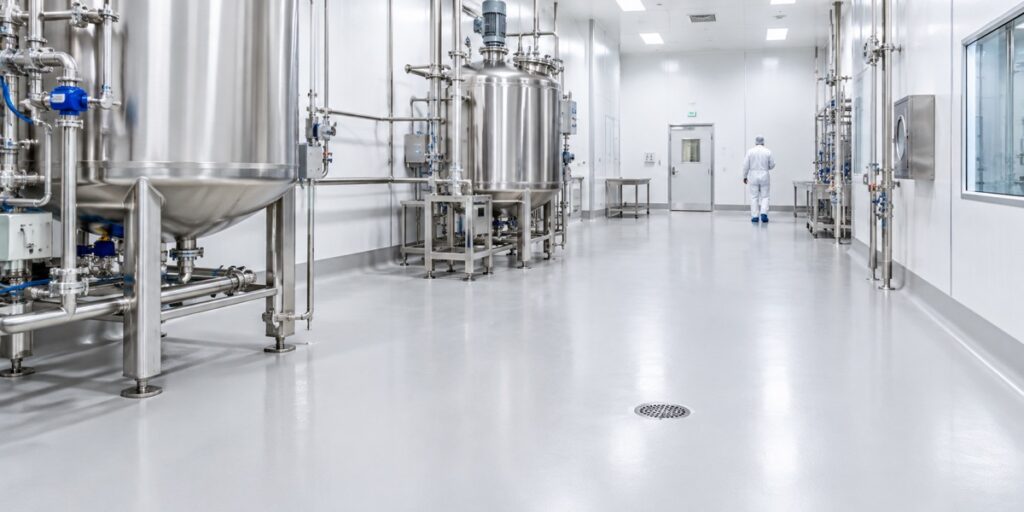
What a failed floor costs in a regulated facility
A crack at a cove, an open joint under a tank, a coating that has started to lift at a doorway. In most plants that is maintenance. In cGMP areas it is a cleaning problem, an audit observation, and sometimes a deviation. And the repair is harder than the install, because now it has to happen around validated production.
Your floor has to stand up to aggressive sanitizers, chemicals, and solvents, rolling equipment, and constant cleaning.
What we look for on a site walk
- Cracks, open joints, and failed coves where residue collects
- Coatings lifting or delaminating at doorways and drains
- Chemical attack from sanitizers and spills
- Worn texture where carts and pallet jacks turn
- Transitions between rooms with different cleaning regimes
Seamless, cleanable, and built for your cleaning program
Seamless systems and integral cove bases
Seamless resinous systems and integral cove bases can reduce joints and crevices and support facility cleaning procedures. Suitability depends on the selected system, installation details, operating conditions, and maintenance.
Chemical and sanitizer resistance
Pharmaceutical floors see harsh cleaning agents, disinfectants, solvents, and process spills every day. We specify systems that hold up to your specific chemicals without softening, staining, or peeling, and antimicrobial systems where you want an added layer of protection.
Built for cGMP areas
We install systems for FDA-regulated pharmaceutical facilities and cGMP production areas. Light, reflective finishes improve visibility in cleanrooms and labs.
Every room has a different job
We do not put one floor through the whole building. We look at what each room does, then choose the system.
Cleanrooms and compounding
Seamless surface, cleanability, light reflectivity. Typical approach: a seamless resinous system with integral cove.
Laboratories
Chemical and solvent resistance, easy spill cleanup. Typical approach: a chemical-resistant epoxy or urethane system.
Processing and wash-down areas
Hot water, thermal shock, sanitizers, drainage. Typical approach: urethane cement, sloped to drain.
Packaging and warehouse
Forklift traffic, impact, abrasion. Typical approach: high-build epoxy or epoxy mortar.
Installed around production, not instead of it
1. Walk the area
We review conditions, cleaning chemicals, gowning and access rules, and the shutdown window with your team.
2. Plan the sequence
Rooms are phased around your schedule and access requirements.
3. Prepare and install
Shot blasting and diamond grinding, moisture and contaminant testing, then the system, with dust and odor contained around adjacent areas.
4. Return to service and follow up
Return-to-service milestones are set for each project. Surface Technology offers annual floor condition inspections for qualifying facilities.
Experience in regulated production
For a nutraceutical manufacturer, we installed seamless epoxy floors and walls on a large, complex project inside an operating facility, with no surprises for the plant team. Since 1988, much of our work has been in regulated environments: pharmaceutical, nutraceutical, food, and laboratory facilities where hygiene and documentation matter as much as durability. We work nights, weekends, and holiday shutdowns.
Pharmaceutical flooring questions
What is the best flooring for a pharmaceutical facility?
It depends on the room. Cleanrooms and compounding areas need a seamless, cleanable surface with integral cove bases. Labs need chemical and solvent resistance. Hot wash-down areas need a system that handles thermal shock, usually urethane cement. We specify by room after we see the conditions.
Why does seamless flooring matter for cGMP areas?
Seamless resinous systems and integral cove bases can reduce joints and crevices and support facility cleaning procedures. Suitability depends on the selected system, installation details, operating conditions, and maintenance.
Can you install flooring without disrupting validated production?
Yes, with planning. We phase the work room by room, schedule around your shutdowns, nights, and weekends, and choose systems with cure times in mind. Return-to-service milestones are set for each project.
Will the floor stand up to our cleaning chemicals?
We check your sanitizers, disinfectants, and process chemicals before specifying a system, then choose a chemistry rated for them. Tell us what you clean with and how often.
Do you install walls as well as floors?
Yes. We install seamless hygienic wall systems and coved transitions so the floor and wall work as one cleanable surface.