
Manufacturing Floors That Keep the Line Running
On a production floor, the coating has one job: keep the concrete intact under forklifts, dropped parts, chemicals, and static, so the line keeps moving. Surface Technology installs and repairs floors for manufacturing plants and plans the work around your production, not the other way around.
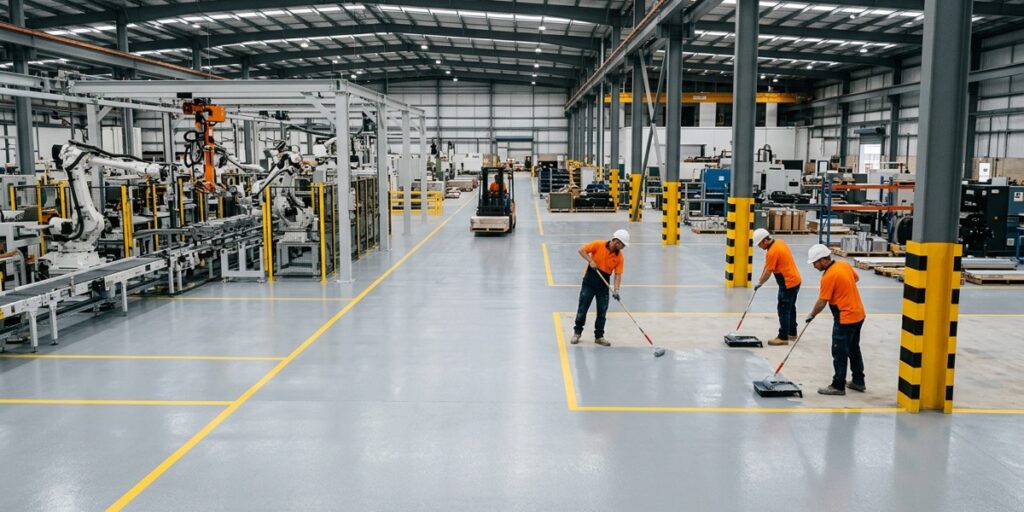
What a failing production floor costs
Floors in manufacturing plants rarely fail all at once. A joint spalls where the forklifts turn. Coolant and oil work into a worn spot. A coating lifts at a dock door and starts to peel back toward the line. By the time someone tapes the area off, the repair has to happen around production, and the schedule pays for it.
Four common failure modes
- Impact and gouging from dropped parts, tooling, and steel wheels
- Abrasion in forklift lanes, at dock doors, and in turning areas
- Chemical attack from oils, coolants, solvents, acids, and cleaners
- Static discharge around electronics, sensitive assemblies, and flammable materials
Floors chosen for what each area does
One plant, several floors
We do not put one coating through the whole plant. We look at what happens in each area, then specify. Impact and machine areas get epoxy mortar or a high-build epoxy. Forklift aisles get abrasion resistance and slip texture. Chemical areas get a chemical-resistant system such as Novolac epoxy or vinyl ester. Containment areas get secondary containment coatings and linings.
Matching the system to the area
Each area has its own job. These are the combinations we specify most.
Production lines and machine areas
Impact, oils, coolants, heavy equipment. Epoxy mortar or high-build epoxy.
Forklift aisles and docks
Abrasion, turning traffic, wet tires. Abrasion-resistant epoxy with anti-slip texture.
Chemical storage and process areas
Acids, solvents, spills. Chemical-resistant systems.
Tank farms, sumps, and containment
Holding a spill until it is cleaned up. Secondary containment coatings and linings.
Electronics assembly and static-sensitive areas
Electrostatic discharge and ignition risk. ESD conductive or dissipative flooring.
Areas that cannot be down long
A tight shutdown window. Fast-curing MMA or a phased install.
ESD flooring for static-sensitive production
Electrostatic discharge damages components and can ignite flammable vapors and dust. An ESD floor gives that charge a controlled path to ground. We install conductive and dissipative epoxy and urethane systems over concrete for electronics manufacturing, assembly, and areas that handle combustible or flammable materials for static control.
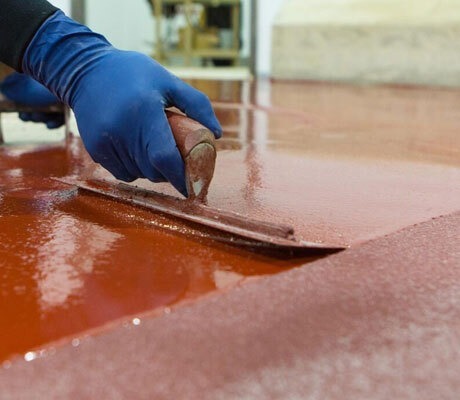
Working in chemical processing?
Chemical plants, power plants, and wastewater facilities need floors and linings that stop corrosion before it reaches the concrete, plus containment that holds when something leaks. We cover those environments in detail on our chemical processing page.
Installed around your production schedule
1. Walk the floor
We look at the slab, joints, traffic routes, chemicals, and where the damage is coming from.
2. Plan the window
A planned shutdown, a weekend, or a phased install area by area while the rest of the plant runs.
3. Prepare and install
Shot blasting and diamond grinding, joint and crack repair, moisture testing, then the system.
4. Back in service
Return-to-service requirements depend on the specified system, site conditions, and intended use. Surface Technology offers annual floor condition inspections for qualifying facilities. When a floor fails without warning, Surface Team Six™ handles urgent repairs.
Proven under tight schedules
A 40,000 square foot port warehouse, ready for a contract start date. An international vehicle logistics company was upgrading its Port of Baltimore warehouse before a new contract began. The old floor had multiple elevations to level, heavy prep, and no HVAC in the building. We removed the old finishes, repaired and regraded the floor, and installed a quarter-inch urethane cement topping with a chemical-resistant finish and anti-slip texture. The floor was back in full service 24 hours after completion.
Manufacturing flooring questions
What is the most durable flooring for a manufacturing plant?
For heavy impact and machine areas, epoxy mortar or a high-build epoxy system is the usual answer. Forklift aisles need abrasion resistance and slip texture. Chemical areas need a chemical-resistant system such as Novolac epoxy or vinyl ester. The right floor is usually a combination, specified area by area.
Can you replace a floor without stopping production?
Usually, yes. We phase the work so one area is down while the rest of the plant runs, schedule it around nights, weekends, and planned shutdowns, and choose systems by cure time. Return-to-service requirements depend on the specified system, site conditions, and intended use.
Do you install ESD flooring?
Yes. We install conductive and dissipative ESD floor systems for electronics manufacturing and for areas that handle combustible or flammable materials.
Can you repair damaged concrete before coating it?
Yes. Concrete repair is part of preparation. We repair spalled joints, cracks, and holes, correct moisture problems, and level uneven areas before the new system goes down.
Do you do secondary containment?
Yes. We install secondary containment coatings and linings for tank farms, sumps, and chemical storage, chosen for the chemicals they have to hold.